



Best Cars for Transfers with Large Luggage
Choose sedan, estate, minivan or large van based on passenger count and luggage volume for stress-free airport transfers.
Best Cars for Transfers with Large Luggage
If you have more bags than seats can comfortably handle, move up one vehicle class. That is the main rule I’d use for airport transfers in Spain.
In simple terms:
- Sedan: best for 1 to 3 people with 2 to 3 standard suitcases
- Estate car: best for 3 to 4 people with extra boot room for prams, strollers, or more bags
- Minivan: best for 5 to 7 people who want to stay in one vehicle with several cases
- Large van: best for 8+ people or anyone carrying oversized gear like golf clubs, surfboards, or pushchairs
That matters because a car that fits your group on paper can still feel tight once you add large suitcases, cabin bags, child seats, or sports kit. The article also points to airport pickup details such as 45 minutes of free waiting time, flight tracking, and child-seat requests at booking.
The BEST 9-Seater Minibuses for Airport Transfers in 2026!
sbb-itb-ff87004
Quick Comparison
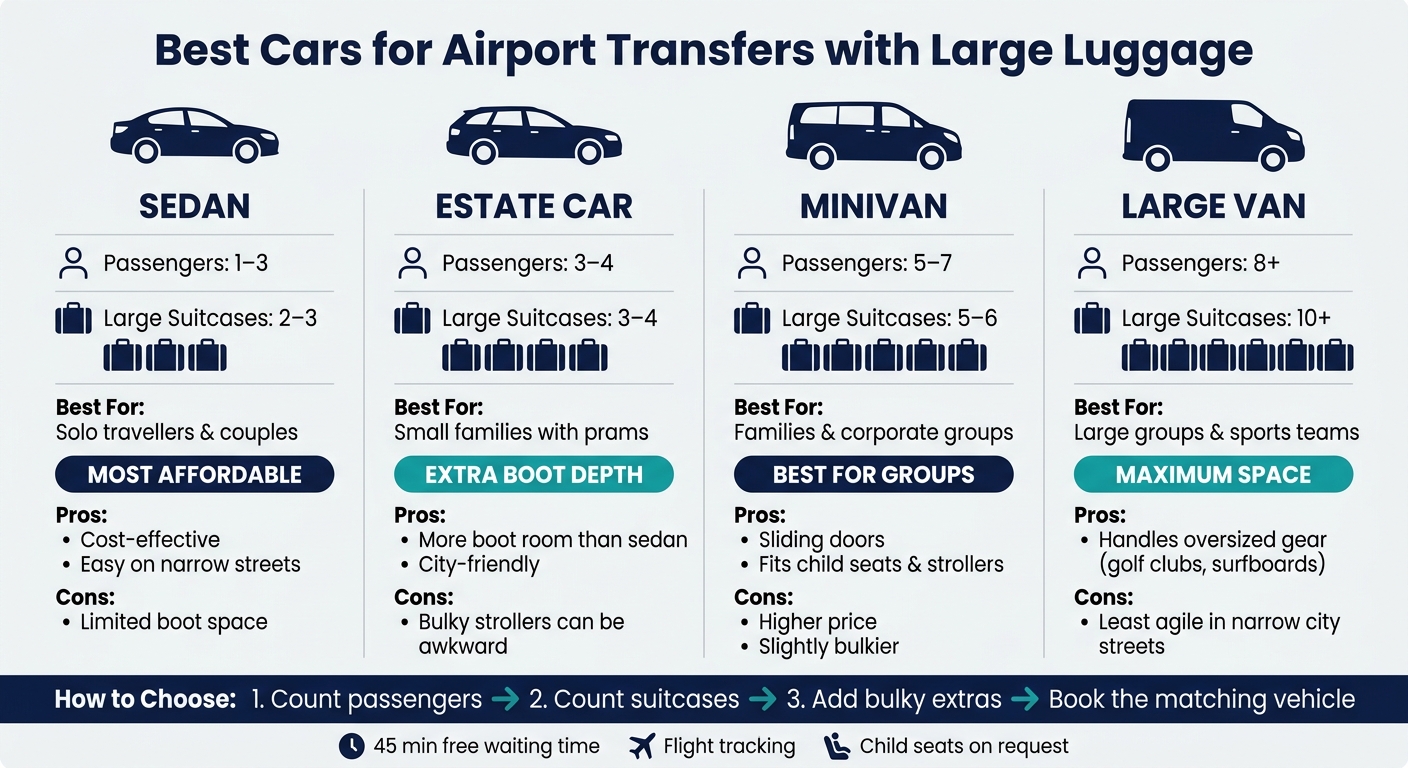
Best Cars for Airport Transfers: Capacity & Luggage Guide
| Vehicle | Best group size | Luggage fit | Best use |
|---|---|---|---|
| Sedan | 1–3 | 2–3 standard suitcases | Short airport-to-city rides with light luggage |
| Estate car | 3–4 | More boot space than a sedan | Small families with prams or extra bags |
| Minivan | 5–7 | Several large cases plus cabin bags | Families and work groups travelling together |
| Large van | 8+ | Heavy or oversized loads | Big groups and bulky luggage |
I’d sum it up like this: pick by passenger count first, then check suitcase volume, then add bulky items. If you enter all bags and extras correctly when you book a transfer online, you cut the risk of ending up with a car that is too small.
1. Sedan
A sedan works best for solo travellers, couples, or small groups of up to 4 passengers with standard luggage. The main thing to check is simple: how many people and suitcases can fit without squeezing everything in.
Compared with larger vehicle types, a sedan gives you the least room for bags. But for light travel, it's also the simplest and most efficient choice. If your group has more than three large suitcases, it's better to move up to an estate car or minivan.
Passenger Capacity
Best with 3 passengers and full-size suitcases.
Suitcase Capacity
The boot usually fits 2 to 3 standard suitcases. That makes a sedan a good match for short, direct rides instead of trips with heavy luggage.
Best Transfer Use Case
Best for direct airport-to-city rides when luggage is light.
Airport Features
For airport pickups, comfort for a small group matters just as much as boot space. Drivers track flights in real time. Airport pickups include 45 minutes of free waiting time. Drivers meet you in the arrivals hall with a name sign.
Family Features
Child seats, baby seats, and Maxi-Cosi can be requested at booking.
2. Estate Car
An estate car is a smart pick for small groups travelling with more bags than a sedan can handle. The longer boot gives you space for standard suitcases, plus bulkier items like prams, strollers, or extra holiday bags. So if luggage space matters more than extra seats, this option usually makes more sense.
Passenger Capacity
Fits up to 4 passengers.
Suitcase Capacity
The boot can take standard suitcases along with prams, strollers, or extra holiday bags. It’s a good fit when you’re bringing items that simply won’t go into a sedan boot. For airport-to-city transfers, that extra boot room often helps more than a larger cabin.
Best Transfer Use Case
Best for families of 3 to 4 travelling with prams, strollers, or extra bags.
3. Minivan
When an estate car just doesn’t cut it, a minivan gives your group the room to stay together without cramming people or luggage in awkwardly. It’s a simple pick for trips where bags matter just as much as seats.
Passenger Capacity
Fits 6+ passengers in a single vehicle. That means the whole group can travel together instead of splitting across cars.
Suitcase Capacity
A business van can hold 4 large suitcases and 3 cabin bags. If you’re travelling with pushchairs, work gear, or other bulky items, that extra boot space goes a long way.
Best Transfer Use Case
Best for families and corporate groups that need to travel together.
Airport and Family Features
Airport pickups include 45 minutes of free waiting time, real-time flight tracking, and child-seat options on request.
4. Large Van
If a minivan still feels a bit cramped, a large van gives you the extra room that makes the trip much easier. You get more space for passengers, more space for bulky luggage, and one simple setup that keeps the whole group in the same vehicle.
Passenger Capacity
Large vans are a good fit for 6+ passengers when luggage volume makes smaller vehicles hard to use. The main difference compared with a minivan is simple: you need more seats and more boot space at the same time.
That matters when you're trying to keep the group together instead of splitting people or bags across two vehicles.
Suitcase Capacity
These vans are built to handle pushchairs, sports gear, and oversized bags. So if bulky luggage is the thing causing trouble, a large van usually solves it.
That makes this option a good match for airport transfers where standard luggage space just won't cut it.
Best Transfer Use Case
Large vans work best for large families and corporate groups travelling with heavy luggage loads. They are the strongest fit for airport-to-city transfers with multiple large bags.
For smaller groups, though, the next vehicle category down may still do the job.
Family Features
Child seats, baby seats, and Maxi-Cosi carriers are available on request, so it's best to add them during the booking process.
5. 7transfers
Once you know the right vehicle size, the next step is just as important: booking it the right way. You can compare vehicle types all day, but the booking stage is what determines whether the correct one gets assigned.
That’s where 7transfers comes in. You enter the number of passengers and bags, and the booking system matches the vehicle to the load.
Passenger and luggage count
When booking, add the total number of passengers and bags so the system can assign the right vehicle. Larger groups or families travelling with pushchairs and several bags are usually matched to minivans or large vans.
Luggage Handling
Vehicle selection is based on the luggage details entered during booking. If you’re travelling with bulky items, entering the exact number of large suitcases and cabin bags helps make sure the right vehicle is allocated.
Capacity and Family Travel: How Each Vehicle Compares
Your vehicle choice should match both your group size and your luggage. A car that fits five people on paper can still feel cramped if everyone brings large cases.
Use the comparison below to pick the right size before you book.
| Vehicle | Passengers | Large Suitcases | Best For | Spain airport-to-city notes |
|---|---|---|---|---|
| Sedan | 1–3 | 2 | Solo travellers & couples | Ideal for quick transfers in Madrid or Barcelona |
| Estate Car | 3–4 | 3–4 | Small families | Extra boot depth fits a folded pushchair |
| Minivan | 5–7 | 5–6 | Families & business teams | Ample space for multiple child seats and bulky gear |
| Large Van | 8+ | 10+ | Large groups & sports teams with oversized gear | Essential for oversized items like golf clubs or surfboards |
A simple rule: if you're travelling with children, prams, sports kit, or several large suitcases, it's often worth moving up one vehicle category. That extra room can make the airport-to-city trip much less stressful.
You can also request child seats, baby seats, or Maxi-Cosi when booking.
Pros and Cons of Each Vehicle Type
Once you know how much space you need, the next step is simpler: look at the day-to-day trade-offs. Access, loading, and price all change depending on the vehicle. And in Spain, that matters. Narrow city-centre streets can turn a simple pickup into a bit of a squeeze.
Here’s the practical breakdown:
| Vehicle | Pros | Cons | Best Booking Scenario |
|---|---|---|---|
| Sedan | Most cost-effective; easiest to navigate narrow streets | Limited boot space; poor fit for oversized items | Solo travellers or couples with standard luggage |
| Estate Car | Better boot depth than a sedan; compact enough for city driving | Bulky items and large strollers can be awkward to load | Small families (3–4 people) with a little more luggage than a sedan |
| Minivan | Sliding doors make loading easy; fits strollers and multiple bags; groups can travel together | Higher price than a sedan; slightly bulkier in very tight city centres | Families with young children or corporate teams who want everyone in one vehicle |
| Large Van | Maximum space for oversized gear; spreads the transfer cost across more passengers | Least agile in narrow streets; access can be tight in historic centres | Sports teams, large families, or travellers with oversized gear |
A Sedan is usually the lowest-cost option, and it’s the easiest to handle on tight streets. That makes it a solid fit for solo travellers or couples with normal luggage. The downside is simple: boot space runs out fast, especially if you have large suitcases or anything awkwardly shaped.
An Estate Car gives you more depth in the boot without feeling too big for city driving. It works well for small families or anyone carrying a bit more than a sedan can handle. That said, if you’re dealing with bulky items or a large stroller, loading can still be a hassle.
A Minivan makes life easier when loading matters. Sliding doors help in cramped pickup spots, and there’s room for strollers, several bags, and a full group in one vehicle. You’ll pay more than for a sedan, and in very tight historic areas it can feel a bit less nimble.
A Large Van gives you the most room, which is useful for oversized gear or bigger groups. It can also make sense on price per passenger when the cost is split. The trade-off is street access: in older parts of Spanish cities, these vehicles are the hardest to move around and park near the pickup point.
Loading ease matters most when bags are bulky or the pickup point is tight.
If your luggage is pushing the boot limit, move up a class.
Conclusion
Choose based on passenger count and luggage volume. Put simply: a sedan works for light travel, an estate car gives you more boot space, a minivan suits families or small groups, and a large van fits bulky loads or bigger parties. So the final choice is simple: match the car to both the number of passengers and the amount of luggage.
Once you know the vehicle size, the last step is to enter your full luggage list correctly. Check the number of suitcases, hand luggage, and any oversized items such as sports gear or a wheelchair, along with any child-seat needs. Those details decide the vehicle assigned.
Book with 7transfers by entering passengers, bags, and extras, and the system matches the right vehicle.
FAQs
What if my luggage count is borderline?
If your luggage count is close to the limit, book the next vehicle category up. That gives you a bit more room in the boot, so your suitcases and hand luggage don’t end up packed in too tightly.
When you book, enter your total luggage and hand luggage separately so 7transfers can match you with a suitable vehicle. If you’re between sizes, choosing the larger option can help you avoid cramming bags into airport-to-city transfers.
Do folded wheelchairs count as oversized luggage?
Yes. At 7transfers, a folded wheelchair is treated as an important luggage or accessory item.
You can add it as an extra when you book. That way, the driver assignment can match the number of passengers and the amount of luggage, so the trip feels comfortable from the start.
Can I add child seats and extra bags after booking?
Yes. You can request child seats, including baby seats and Maxi-Cosi. You can also add these extras after booking through the extras flow.
If you need extra bags, contact customer support before pickup so the right driver or vehicle can be arranged. Extra charges may apply if changes are made.