



Private Transfer vs Rideshare: Key Differences Explained
Private transfers deliver certainty, space, and meet‑and‑greet for airports and groups; rideshares suit short, flexible city trips.
Private Transfer vs Rideshare: Key Differences Explained
If I want the safest bet for an airport pickup, I book a private transfer. If I want a short city ride and can wait a bit, I use rideshare.
Here’s the short answer:
- Private transfer = booked before travel, fixed pickup, fixed fare, driver waiting for me
- Rideshare = booked when I need it, price may change, wait time depends on nearby drivers
- For late-night arrivals, families, groups, and work trips, private transfer usually fits better
- For short, flexible trips with light luggage, rideshare can be enough
A few points stand out straight away:
- Private transfers often include flight tracking and 30–45 minutes of waiting time
- Rideshare airport waits can run from 5 to 20+ minutes
- Extras like child seats, extra luggage space, and return trips are easier to sort out before travel with a private transfer
- A fixed fare in Spain means I know the price in € before I leave, which helps after a long flight or a 23:30 arrival
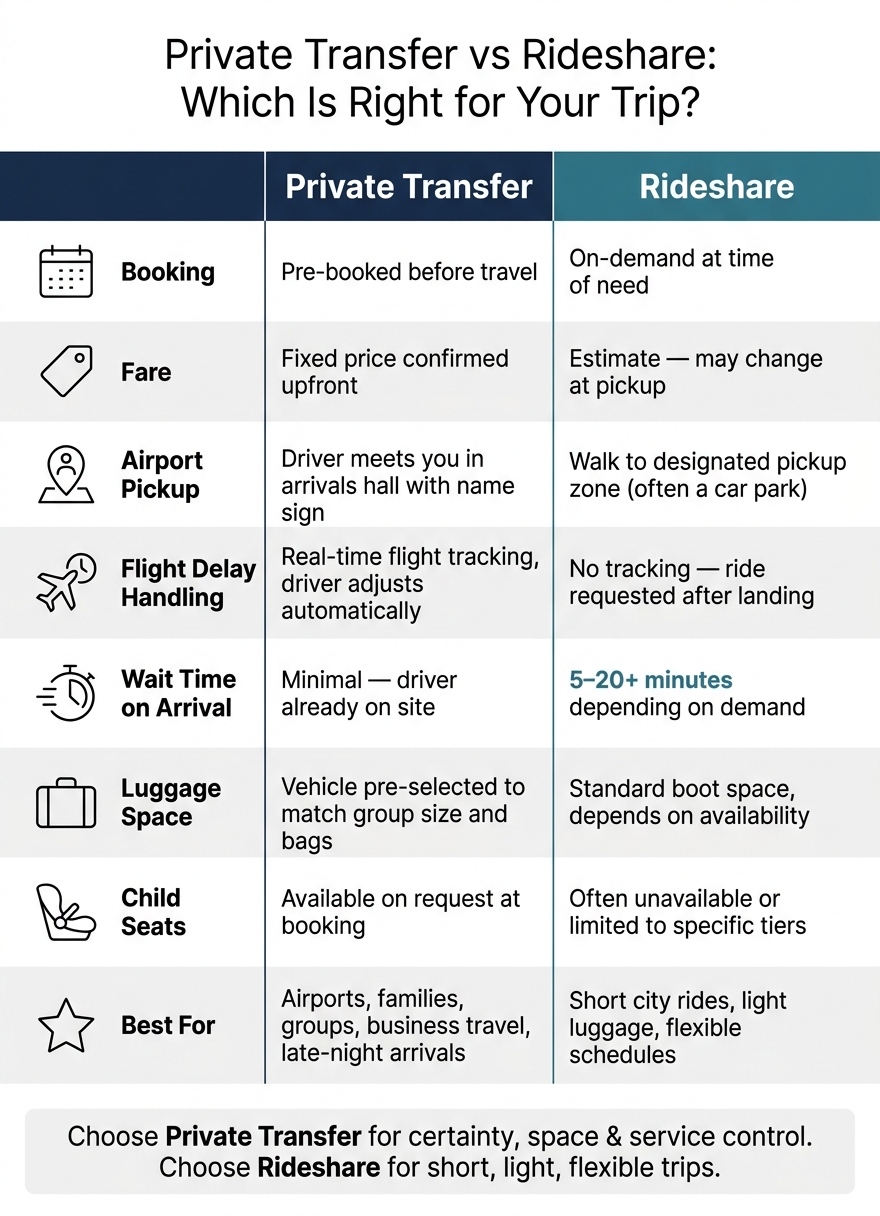
Private Transfer vs Rideshare: Side-by-Side Comparison
Taxi vs. Rideshare, Which is Better? The Pros and Cons of Both
sbb-itb-ff87004
Quick Comparison
| Point | Private Transfer | Rideshare |
|---|---|---|
| Booking | Pre-booked | On-demand |
| Fare | Fixed before travel | Estimate that may change |
| Airport pickup | Driver meets me in arrivals | I go to a pickup zone |
| Flight delays | Usually tracked | Not tracked in advance |
| Wait time | Usually low on arrival | Often 5–20+ min |
| Luggage | Vehicle chosen for the trip | Depends on what is available |
| Child seats | Can be added when booking | May not be available |
| Best use | Airports, families, groups, work trips | Short city rides |
Put simply, I’d choose based on certainty, price control, pickup ease, luggage space, safety, and trip type. That’s the whole decision in one view.
Pre-booked vs On-demand: Booking Process and Trip Certainty
The main difference comes down to timing. A private transfer is arranged before you travel, while a rideshare is requested once you arrive. That one detail shapes the whole booking experience.
How Booking in Advance Changes the Travel Experience
With a private transfer, you usually get instant confirmation by email, and your driver details plus pickup instructions are sent before the trip. That can make a big difference for early-morning departures or late-night arrivals after 23:00, when finding a driver may be harder.
Booking ahead also gives you more control before the journey starts. You can sort out things like:
- a return leg
- an extra stop
- a child seat
All of that can be added upfront. Free cancellation is often available up to 24 hours before pickup, and some services allow changes as late as 6 hours before pickup.
When On-demand Booking Is Enough
A rideshare makes sense for simple city trips. Think a short journey across the city centre, a daytime ride with light luggage, or any case where you’re fine making your way to a designated pickup zone after landing.
If your schedule is flexible and your destination is well covered by on-demand apps, booking ahead may not be needed. The catch is simple: availability, wait time, and the final fare only become clear after you request the ride.
Once the booking method is clear, the next step is to look at how much of the fare is fixed before you travel.
Price Transparency: Fixed Fare vs Variable Cost
A private transfer shows the full fare upfront. An on-demand ride usually shows an estimate, and that number can change before pickup.
What the Quoted Price Usually Covers
With a pre-booked private transfer, the quoted fare often includes the driver, meet-and-greet, flight tracking, and 30–45 minutes of waiting time at no extra charge.
A few extras can still increase the total. Common ones include child seats, wheelchair assistance, or add-ons such as extended flight delay protection. Some bookings also include a card-processing fee at checkout. The key difference is simple: you see these costs before you pay, not after.
How Peak Demand Changes the Final Cost
On-demand transport works in a different way. The fare shown when you request the ride is an estimate, not a fixed promise. During busy arrival periods, public holidays, or late-night hours, higher demand can push the final price up.
For late-night arrivals, a fixed fare in euros takes one more moving part out of a trip that may already feel messy.
Price is only one part of the choice; next, compare how each option handles delayed flights, waiting time, and airport pickup.
Pickup Reliability, Wait Times, and the Arrival Experience
After landing, most people don't want to deal with guesswork. They want to know who's picking them up, where to go, and how long it'll take. That's where the gap between a private transfer and a rideshare shows up first. It usually starts with flight delays, then moves straight into waiting time on the ground.
Flight Delays, Waiting Policies, and Scheduled Pickup
For airport arrivals and scheduled rides, pickup reliability is where things get serious. With a pre-booked private transfer, the driver follows your flight in real time and adjusts the pickup time automatically if your plane lands late or early.
A pre-booked transfer also comes with a free waiting window, so small delays don't throw the whole plan off. Some add-on protection plans, such as 7Transfers Plus, extend flight-delay cover for up to 3 hours without any extra waiting-time charge. The main point is simple: if your flight shifts, the driver still shows up.
Rideshare works differently. There's no advance flight tracking. You book the ride only after you land, so everything depends on how many drivers are nearby at that exact moment. If the airport is busy or you arrive late at night, wait times can stretch from 5 to 20+ minutes, depending on driver availability.
Meet-and-Greet and Finding Your Driver Quickly
A private transfer driver will usually be waiting in arrivals with a name sign. That makes the handoff much easier, especially if you're travelling with children, carrying several bags, or landing in an airport you don't know well.
With a rideshare, you normally need to walk to a designated pickup area, often in a car park. That may be fine when you're travelling light and know the airport layout. But for people who want the clearest, easiest handover after landing, meet-and-greet takes away a lot of the friction.
You can see the difference more clearly side by side:
| Feature | Private Transfer | Rideshare |
|---|---|---|
| Pickup certainty | Confirmed in advance; vehicle assigned before arrival | Subject to driver availability at arrival |
| Flight delay response | Real-time flight tracking; driver moves pickup time automatically | No tracking; ride is requested after landing |
| Average wait on arrival | Minimal; driver is already on site | 5–20+ minutes depending on demand |
| Meeting point | Arrivals hall, personalised sign | Designated pick-up point, often in a car park |
| Late-night reliability | High; pre-booked and confirmed | Variable; depends on active drivers nearby |
Vehicle size, luggage space, and safety are the next things to look at.
Vehicle Type, Luggage, Safety, and Best Use Cases
Once pickup timing is sorted, the next step is simple: does the vehicle actually fit your trip?
That means looking at passenger space, luggage room, and the level of service you expect. At this stage, the main issue is no longer arrival time. It’s whether the ride matches what you need.
| Feature | Private Transfer | Rideshare |
|---|---|---|
| Driver profile | Professional chauffeurs, vetted and often multilingual | Vetted drivers, rated by passengers |
| Vehicle assignment | Pre-selected based on group size and luggage needs | On-demand request; vehicle type depends on local availability |
| Business/VIP suitability | High; suits scheduled meetings and travellers who need a quiet, predictable ride | Moderate; ad-hoc nature may lack corporate-level predictability |
| Luggage capacity | Space matched to passenger count and luggage | Limited to standard vehicle boot space |
| Child-seat availability | Available on request during booking | Often unavailable or requires a specific tier |
| Safety expectations | Named driver, controlled pickup, and higher service consistency | Moderate; real-time GPS tracking and route sharing available |
Best for Families, Groups, and Travellers with Extra Luggage
Private transfers give you more control before the trip even starts. You pick the vehicle size in advance, so a family of six can book a minivan and know there’s room for strollers, extra suitcases, and everyone in the group. Child seats can also be confirmed when booking.
With rideshare, that part is less certain. Standard vehicles usually come with limited boot space, which can turn into a headache if you’re carrying sports equipment, oversized luggage, or several bags per person. The vehicle type depends on what’s available nearby, and child seats often aren’t an option unless a certain tier includes them.
Best for Business Travel, Late-night Arrivals, and Unfamiliar Destinations
If you’re heading to a scheduled meeting or arriving at a hotel after midnight, guesswork is the last thing you need. Private transfers fit fixed plans better. They come with verified chauffeurs and a quieter, more predictable service style that suits business travel well.
That matters in places you don’t know, too. When the destination is unfamiliar, a named driver and a controlled pickup can feel a lot less chaotic than waiting to see what turns up.
Conclusion: Matching the Transport Type to the Trip
The best option depends on the trip itself. A private transfer makes more sense when timing is fixed, luggage is heavy, the group is large, or the destination is unfamiliar. It also suits families who need child seats, business travellers who want reliability, and late-night arrivals who don’t want to hang around.
A rideshare works better for short, flexible trips when you’re travelling light, know the area, and don’t mind some variation in price and wait time. Put simply: choose a private transfer for certainty, space, and service control; choose a rideshare for short, light, flexible trips.
FAQs
Which option is better for a delayed flight?
A pre-booked private transfer is usually the better pick if your flight is delayed. Most professional private transfer services track flights in real time, so the chauffeur can adjust the pickup time and wait for you without charging extra.
Many services also include a grace period for waiting time. That makes them more predictable than on-demand rideshare apps when flight plans go sideways.
Can I book a child seat in advance?
Yes. When you book your private transfer, you can ask for a child seat, baby seat, or maxi-cosi in advance.
It’s best to add this when you make the booking, so everything is ready for your trip. That way, your family gets a safer, more comfortable, and more relaxed journey from the start.
How much luggage space do I need?
Think about how much luggage you’re bringing so the trip feels comfortable from the start. With a pre-booked private transfer, the vehicle can be matched to both the number of passengers and the amount of baggage.
When you book, share the exact size of your group and your luggage details. That way, the right vehicle can be assigned.