


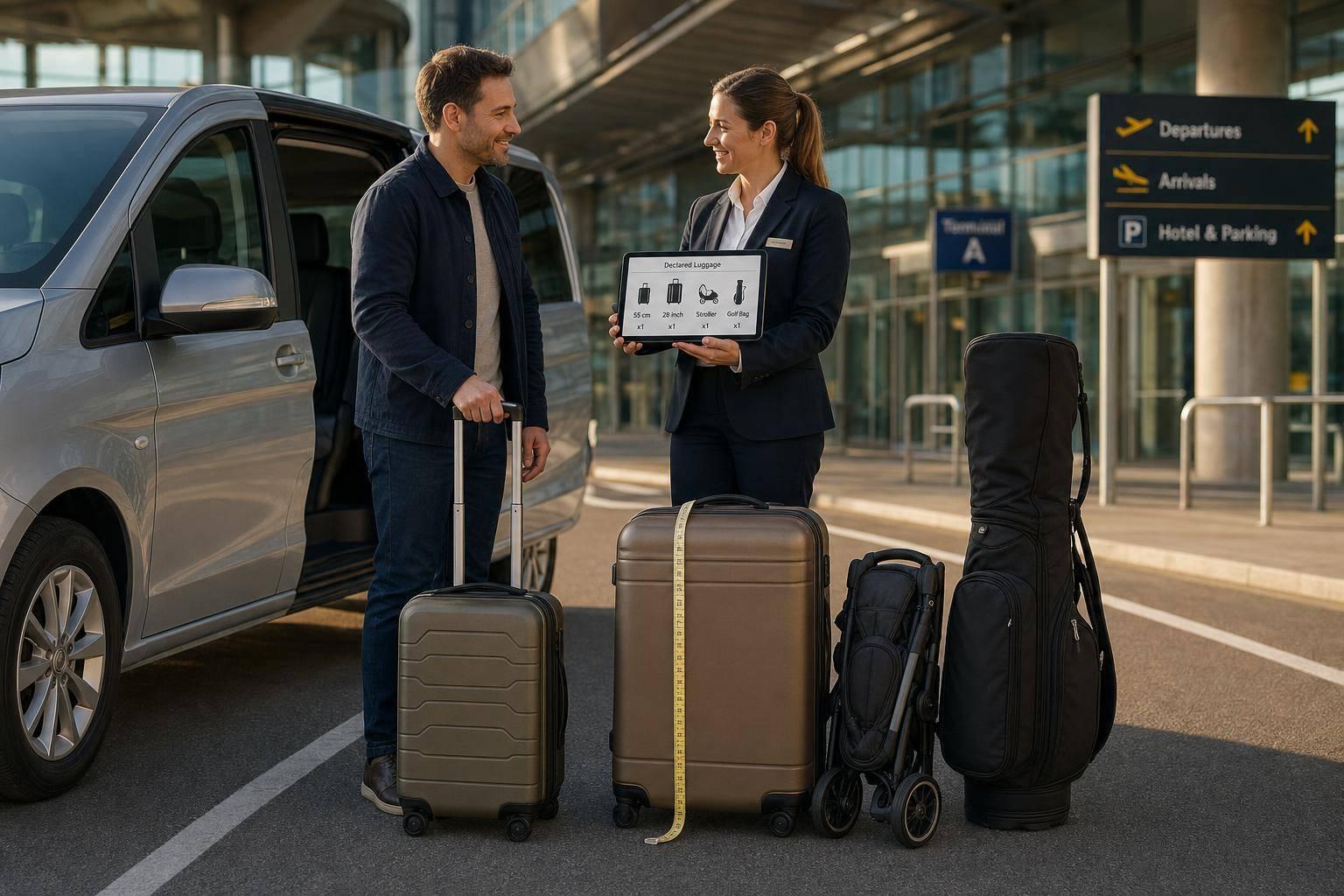
What Luggage Details Matter for Airport Transfers?
Declare every bag, its size and any bulky items before booking so your transfer vehicle fits and avoids extra charges.
What Luggage Details Matter for Airport Transfers?
A transfer can fail even when the passenger count looks fine. In many cases, the issue is not seats but boot space.
When I book an airport transfer, I should give more than the number of passengers. I should list every bag, note rough sizes, and declare anything bulky or rigid such as golf bags, skis, strollers, wheelchairs, or a travel cot. A standard checked case is often around 23 kg and 158 cm total dimensions, while a cabin bag is often near 55 × 40 × 20 cm. Those details help the company send a car that fits both people and luggage.
Before I confirm, I should check these points:
- Total number of bags
- Checked bags and cabin bags
- Approximate size and type of each bag
- Oversized items and sports gear
- Strollers, prams, wheelchairs, and walkers
- Child seats, baby gear, and children’s extra bags
- Any change after booking, as that may affect the final price
A simple rule: if an item takes space in the boot or cabin, I should declare it.
This article explains the luggage details that matter most, so I can avoid delays, a vehicle change, or extra cost on the day.
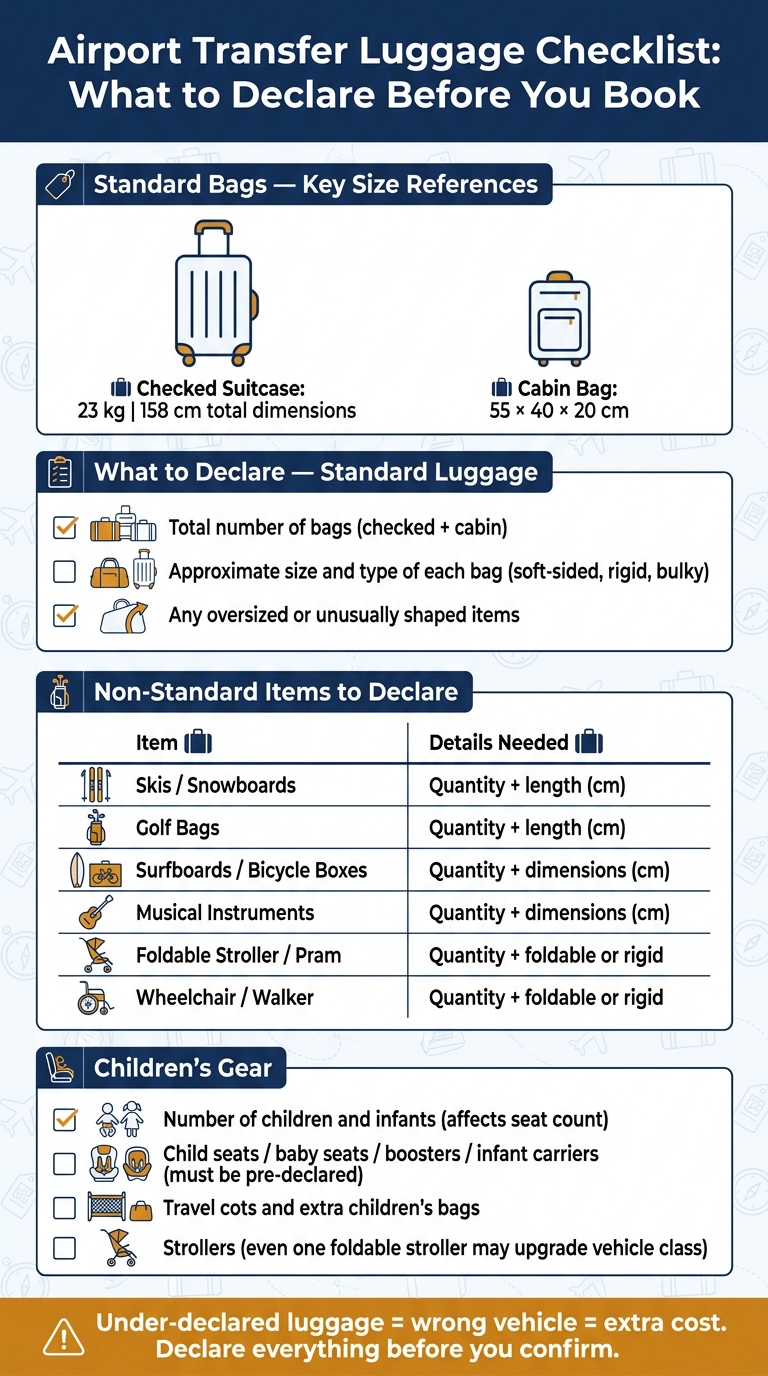
Airport Transfer Luggage Checklist: What to Declare Before You Book
Which luggage details should you provide when booking?
Before you confirm a transfer, share the exact number of bags you're bringing: checked bags, cabin bags, and any bulky items. Then go one step further and describe the size and type of each one. The bag count matters, but on its own, it doesn't tell the full story.
Total number of checked bags and cabin bags
Count each item separately, including suitcases, cabin bags, and backpacks.
As a guide:
- A standard checked suitcase is about 23 kg and 158 cm in total dimensions.
- A cabin bag is usually around 55 × 40 × 20 cm.
That level of detail helps the transfer provider plan space properly from the start.
Approximate size and type of each bag
Just listing the quantity isn't enough. A rigid suitcase and a soft-sided holdall may take up very different amounts of room, even if both count as one bag. That's why it helps to note whether each item is soft-sided, rigid, or bulky.
Use the size guides above, and add the shape or type where needed. If an item is oversized or has an unusual shape, declare it separately.
Clear luggage details help the provider assign the right vehicle category from the beginning. That lowers the risk of turning up with more luggage than the vehicle can carry.
sbb-itb-ff87004
Which non-standard items must be declared before booking?
Once you've covered standard bags, the next step is to declare anything bulky, rigid, or oddly shaped. These items can take up more room than people expect, so they often affect the vehicle category.
Oversized items and sports equipment
Declare any item that is bulky, rigid, or awkward to load. Even one large item can change the vehicle category. Skis, snowboards, golf bags, surfboards, bicycles packed in boxes, large musical instruments, and event materials should each be declared separately.
For each item, include:
- Quantity
- Dimensions in centimetres
That small bit of detail helps avoid the classic problem of everything looking fine on paper, then not fitting on the day.
Strollers, wheelchairs, and mobility aids
Wheelchairs, walkers, and strollers also affect luggage space and vehicle choice. Declare foldable or rigid strollers, prams, wheelchairs, and walkers before booking, since these items take up space and may change the vehicle category.
For each one, state whether it is foldable or rigid and give the quantity.
Use the list below to note the details that matter most.
| Item Type | Details to Provide |
|---|---|
| Skis / snowboards | Quantity + length (cm) |
| Golf bags | Quantity + length (cm) |
| Surfboards / bicycle boxes | Quantity + dimensions (cm) |
| Musical instruments | Quantity + dimensions (cm) |
| Foldable stroller / pram | Quantity + foldable or rigid |
| Wheelchair / walker | Quantity + foldable or rigid |
These same details also affect vehicle choice for children's travel gear.
How do children's luggage and travel gear affect vehicle choice?
Travelling with children means more than adding a couple of small bags. Child seats, strollers, and baby gear take up space fast, and that can change the type of vehicle you need. After standard luggage, children’s gear is often the next thing that shifts vehicle choice.
Child seats, children's luggage, and baby equipment
When booking, include the exact number of children and infants in the passenger count so the vehicle meets safety rules and capacity limits. Each child seat takes up a full passenger seat, which leaves less room for the rest of the group.
7transfers offers child seats, baby seats, boosters, and infant carriers on request, but these must be declared during the booking process so the correct vehicle can be assigned in advance. That also applies to other baby items. If you’re bringing a booster, a travel cot, or extra children’s bags, add them during booking so the right vehicle can be assigned.
Why a stroller can change the vehicle category
A stroller may not look like much at first glance, but it can take up a lot of room once it’s folded. In many cases, even one foldable stroller is enough to move a booking from a saloon to an MPV or minivan because it uses both cabin and boot space.
That’s why accurate child-gear details matter. When those details are clear from the start, matching the booking to the right vehicle becomes much simpler.
These details feed directly into vehicle selection.
How accurate luggage details help match the right vehicle
Once all bags and special items are declared, the next step is simple: match the load to the right vehicle. This isn’t just about headcount. A group of four might fit in one car with light luggage, but that same group may need a bigger vehicle if they’re travelling with several large cases.
Matching vehicle type to luggage volume
Use the bag count and item type already declared to match the right vehicle class. Clear luggage details help the provider choose a vehicle that keeps luggage in the boot and the cabin free for passengers.
If luggage is under-declared, the assigned vehicle may be too small. That can lead to an upgrade or even an extra car, with extra cost. Changes to luggage or passenger numbers after confirmation can also affect the final price.
Conclusion: What to check before you confirm your booking
Before you confirm, check that you’ve declared every bag, the size of larger items, and any oversized items, sports equipment, pushchairs, wheelchairs, or mobility aids. That last check helps avoid space issues, delays, and last-minute changes.
FAQs
What if I forget to declare a bag?
If you forget to declare a bag, contact 7transfers support straight away so they can update your booking.
Getting your luggage details right helps match the right vehicle to your passenger count and total bag space. Need to add the number of bags, extra-large items, sports gear, or strollers? Just reply to your booking confirmation email or use the contact form.
Can hand luggage affect vehicle size?
Yes. Hand luggage can affect vehicle size because the vehicle category is matched to the luggage capacity.
When booking, you can specify the number of bags and hand luggage. That way, the transfer can be assigned a suitable vehicle category for your group and luggage.
Do foldable items still need to be declared?
Yes. You should declare all luggage details when booking your transfer with 7transfers, including foldable items.
That means sharing the number, size, and type of everything you’re bringing. It helps match you with the right vehicle and avoids delays, whether the item is foldable or bulky.