


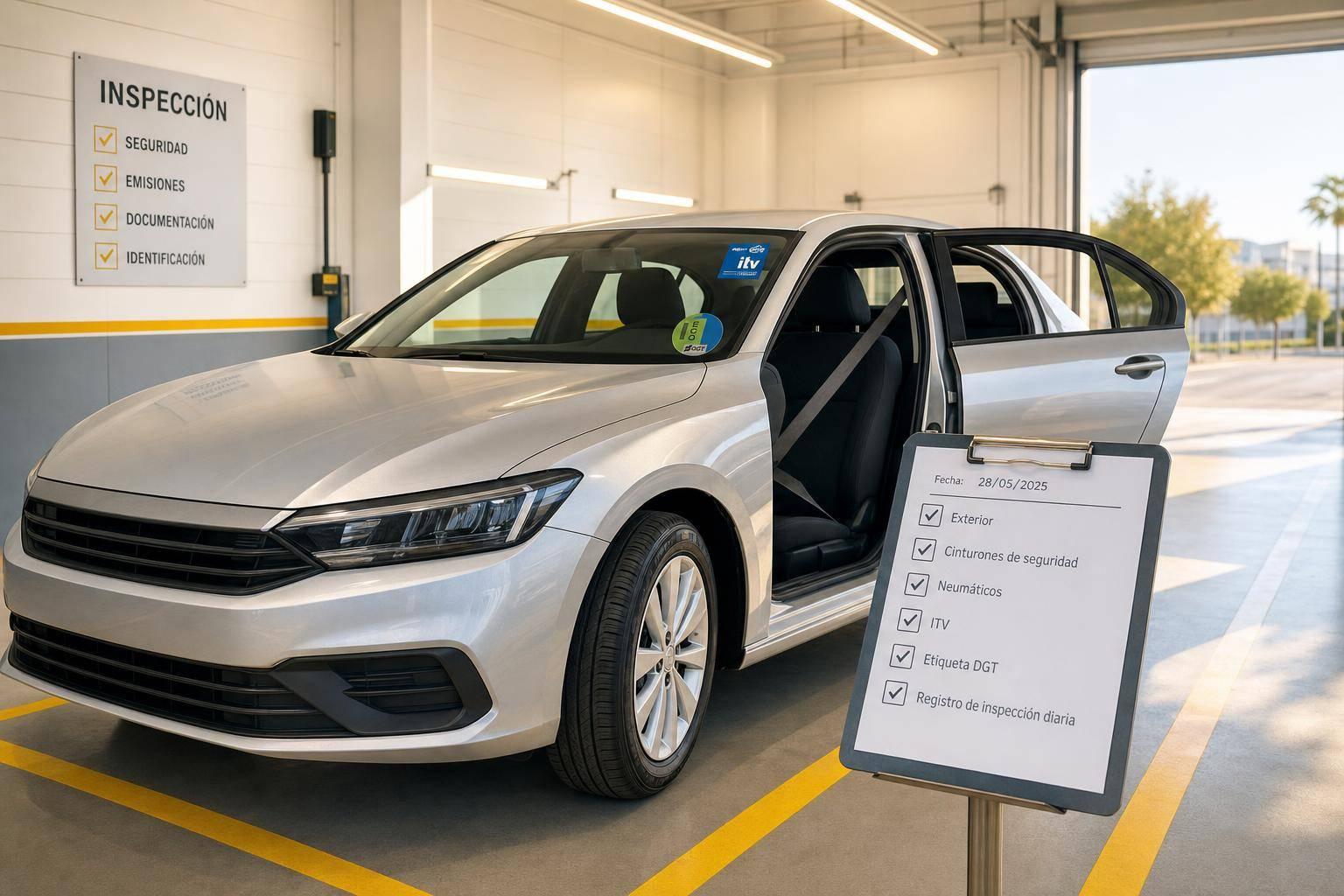
Private Hire Licensing Guide: Vehicle Standards
Essential pre-service checklist for private hire vehicles in Spain: exterior, seat belts, tyres, ITV, DGT labels and daily logged inspections.
Private Hire Licensing Guide: Vehicle Standards
If I had to cut this guide down to one point, it would be this: a private hire vehicle in Spain should not go into service unless its condition, safety items, paperwork, and daily checks are all in order.
In practice, I would check four things first:
- Road condition: bodywork, doors, windows, lights, mirrors, tyres, and wheels
- Passenger safety: seat belts, rear head restraints, and child-seat fixing points where needed
- Paperwork: valid ITV, passenger transport cover, permits, and service records
- Daily go/no-go check: warning lights, leaks, load space, and a logged pre-trip check with a 24-hour time stamp
A few facts matter straight away:
- In Spain, tyre tread must be at least 1,6 mm
- The vehicle should show a valid ITV sticker on the windscreen
- Many cities now check DGT emissions labels for low-emission zone access
- Dates should be logged in dd-mm-yyyy format, with mileage in km
If I were running airport transfers, family trips, or business travel, I would treat local council rules as an extra layer on top of these base checks. The core idea is simple: if any fault affects safety, the vehicle stays off the road until fixed.
This section boils the guide down into one clear standard: check the car, check the safety kit, check the records, then log the daily inspection before dispatch.
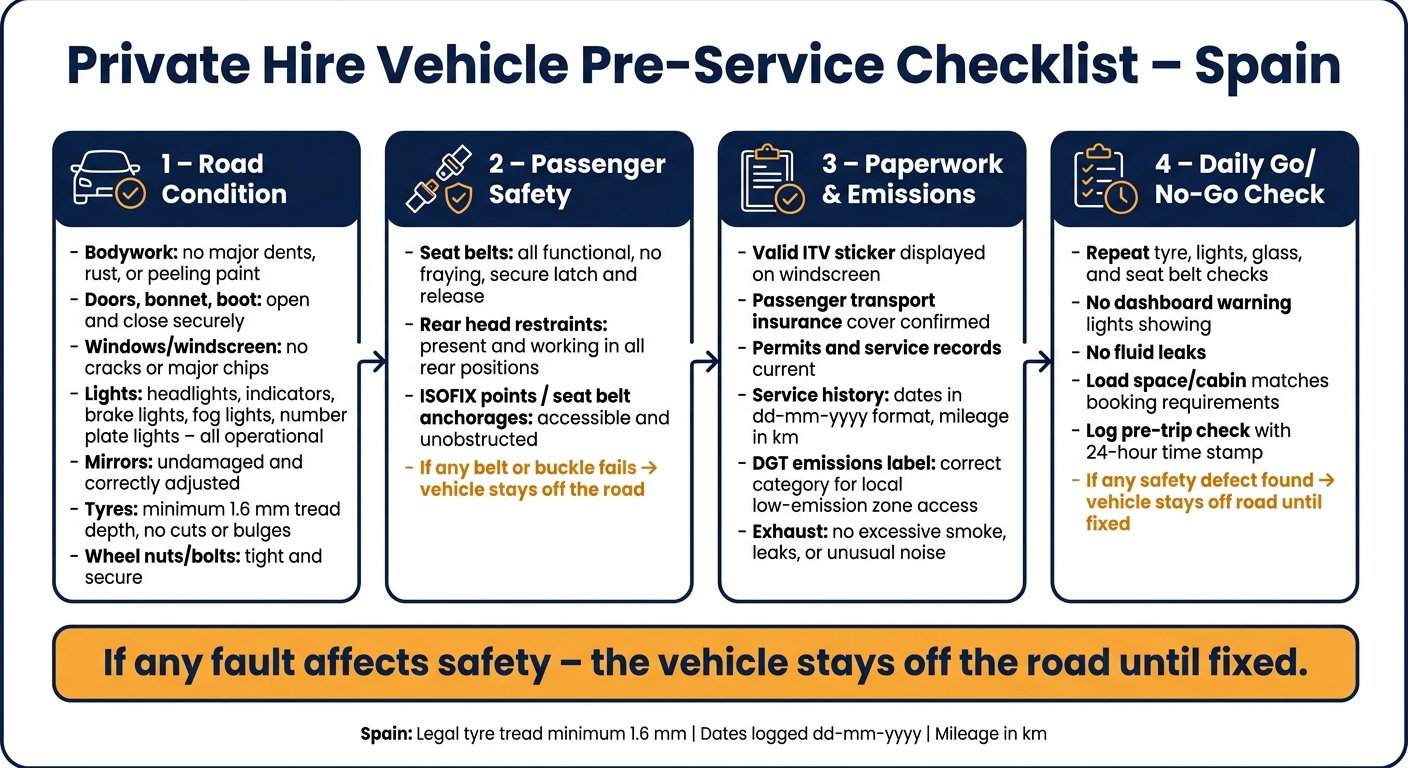
Private Hire Vehicle Pre-Service Checklist: Spain
Exterior Condition Checklist
Exterior condition is part of roadworthiness and licensing checks. Check it before the vehicle enters service.
Start with any visible damage, then move on to lights and identification.
Bodywork, Paint, Doors and Windows
Give the outside of the vehicle a careful once-over.
- Bodywork and paint: No major dents, rust, or peeling paint.
- Trim and fittings: No loose trim, cracked bumpers, or unsecured fittings.
- Doors: All doors, bonnet, and boot must open and close securely.
- Windows and glass: The windscreen and windows must be free of cracks or major chips.
Lights, Mirrors and Licence Plates
Next, make sure the vehicle can be seen, identified, and signalled correctly.
| Item | What to Check |
|---|---|
| Headlights (dipped and full beam) | Both working, correctly aligned |
| Indicators (front and rear) | Flashing correctly; no blown bulbs |
| Brake lights | All functioning when the pedal is pressed |
| Rear lights and reflectors | Undamaged and visible |
| Fog lights | Operational |
| Number plate lights | Illuminating the plate clearly at night |
| Mirrors (wing and rear-view) | Undamaged, correctly adjusted, no cracks |
Licence plates must be clean, fully readable, and unobstructed. Any required local licence markings should also stay visible.
Keep timestamped exterior photos as a condition record.
sbb-itb-ff87004
Passenger Safety Checklist: Seat Belts and Tyres
After the exterior check, it’s time to look at the parts that protect passengers most directly. For licensed transfers, visible safety and proper grip on the road matter before anyone gets in. These are the checks passengers count on most.
Seat Belts, Rear Seats and Child-Seat Readiness
Every passenger seat needs a working seat belt. Check each one for fraying, secure latching, and smooth release.
Rear seats need attention too. Head restraints must be present and working in all rear seating positions. If the booking includes infant seats or child seats, make sure the ISOFIX points or seat belt anchorages are easy to reach and not blocked.
If a belt is frayed or a buckle doesn’t work, the vehicle must stay out of service until it is repaired or replaced.
Then move from passenger protection to the vehicle’s contact with the road.
Tyre Tread, Wear, Damage and Wheel Condition
In Spain, the legal minimum tread depth is 1,6 mm across the full tread. Check all four tyres before each service, including the inner and outer edges.
Look closely at each tyre for cuts, bulges, or exposed cords on the sidewalls. If you spot any of these, the vehicle needs to come out of service at once. Also check that all wheel nuts or bolts are tight and secure. Then confirm that the spare wheel or puncture-repair kit is present and usable.
| Check | Minimum Standard |
|---|---|
| Tread depth | 1,6 mm across full tread |
| Sidewall condition | No cuts, bulges or exposed cords |
| Wear pattern | Even wear across the tread |
| Wheel nuts/bolts | Tight and secure |
| Puncture kit / spare wheel | Present and usable |
Emissions Rules and Inspection Records Checklist
After the safety checks, review the vehicle’s records and emissions status before it goes into service.
ITV Status and Maintenance Records
The ITV is Spain’s roadworthiness inspection. Make sure the vehicle has a valid ITV sticker displayed on the windscreen and that the inspection record is up to date.
Keep the service history clear and easy to follow. That means repair dates in dd-mm-yyyy format and mileage in km. Local licence and inspection paperwork should also be current.
Low-Emission Zone Access and Exhaust Condition
Many Spanish cities limit access based on the DGT label. Check the local low-emission zone rules and confirm that the vehicle has the correct DGT emissions label before service.
It also helps to do a quick daily walk-around of the exhaust system. Look for excessive smoke, exhaust leaks, or unusual noise. Small signs like these can point to a fault that may affect compliance in restricted urban areas.
| Check | What to Look For |
|---|---|
| ITV sticker | Valid and visible on the windscreen |
| Service history | Complete records with dates (dd-mm-yyyy) and mileage (km) |
| DGT emissions label | Correct category for urban zone access |
| Exhaust condition | No smoke, exhaust leaks or unusual noise |
Once the records and emissions checks are clear, move to the driver’s daily walk-around.
Driver Daily Checks and Final Summary
Once the documents and emissions label are sorted, do the final pre-departure walk-around.
Daily Walk-Around and In-Cabin Checks
Before dispatch, repeat the checks that can change overnight: tyres, lights, glass, leaks, seat belts, warning lights, and the load space.
Inside the vehicle, make sure the seat belts work, no warning lights are showing, and the cabin and luggage area match the booking. A vehicle can look fine at first glance and still have a flat warning light issue or a problem in the boot, so this last check matters.
Use the same pre-trip checks for every vehicle, every day. That consistency keeps things simple and cuts down on missed issues.
If a defect affects safety, the vehicle stays off the road until it is fixed. Log the completed check with a 24-hour time stamp so there is a clear record of who cleared the vehicle for service.
Key Points to Check Before the Vehicle Goes Into Service
Use this as the final go/no-go check before passengers board.
| Area | What to Confirm |
|---|---|
| Exterior condition | No new damage affecting safety |
| Seat belts | All functional |
| Tyres | Legal tread; no visible damage |
| ITV and documents | Valid ITV, insurance, and permits |
| DGT emissions label | Correct for local access |
| Daily check log | Logged with a 24-hour time stamp |
FAQs
What faults make a vehicle an immediate no-go?
A vehicle is an immediate no-go if it can’t reliably meet basic safety standards. That includes cases after a breakdown, when there’s a serious maintenance fault, or when required inspections aren’t in place.
In practice, 7transfers notes that vehicles go through strict pre-trip checks, and a service may be refused or cancelled if any issue makes the ride unsafe or non-compliant.
Do low-emission zone rules vary by city in Spain?
Yes. In Spain, low-emission zone rules vary by city.
Each local council sets its own vehicle access rules, restrictions, and emission standards. So the requirements are not the same across the country.
What should a daily pre-trip check record include?
A daily pre-trip check record should include a multi-point vehicle inspection before departure. That check should cover:
- exterior condition
- seat belts
- tyres
- any emissions-related items required by local rules
The record should also include the date and time, the vehicle ID, and the driver ID. On top of that, it should note the driver’s confirmation that the checks were completed that day, and that inspection records are up to date for compliance and safety.