


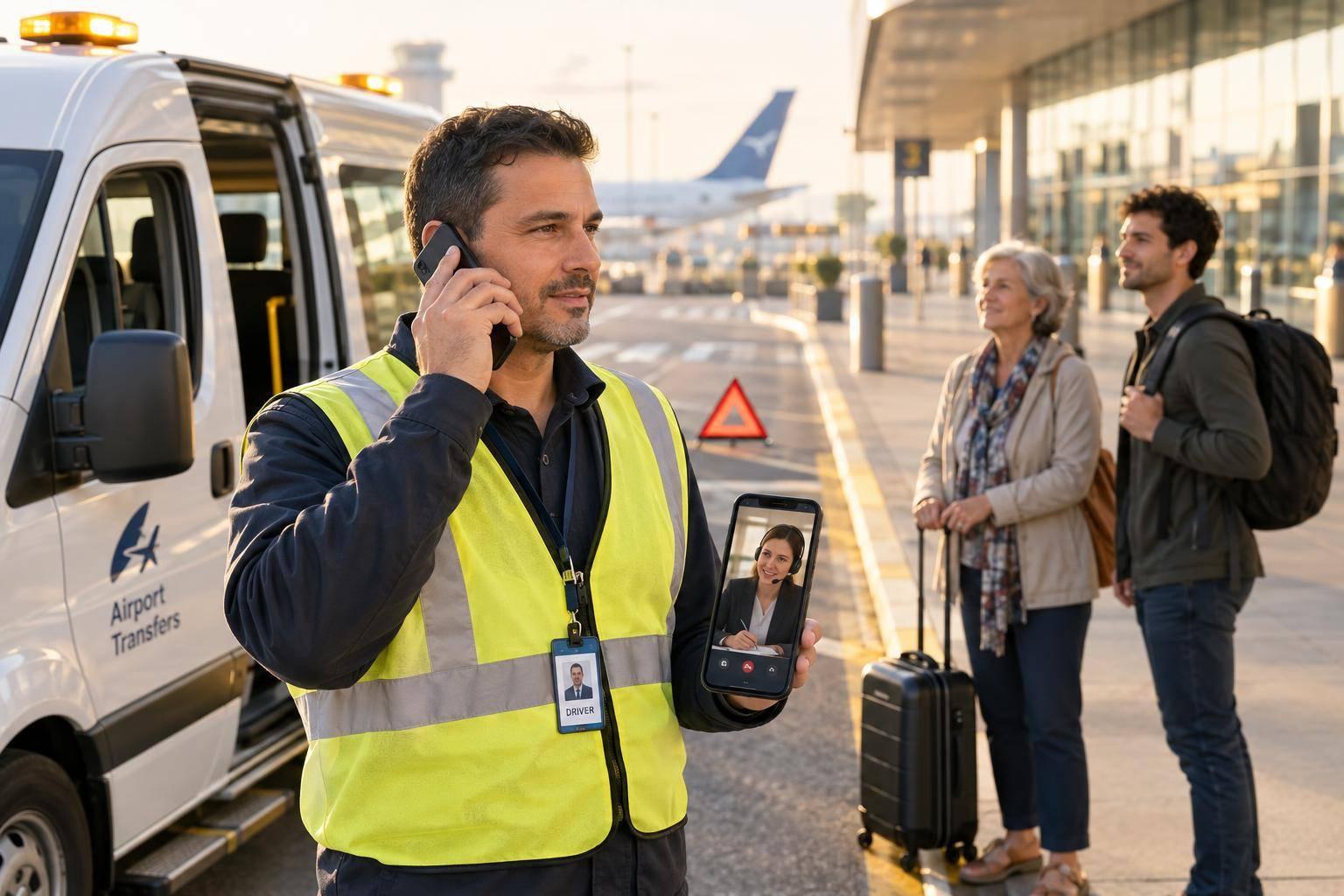
Airport Transfer Incident Response: Driver vs Support
Explains driver vs support roles in airport transfer emergencies: call 112 for danger, driver handles scene, support arranges replacements.
Airport Transfer Incident Response: Driver vs Support
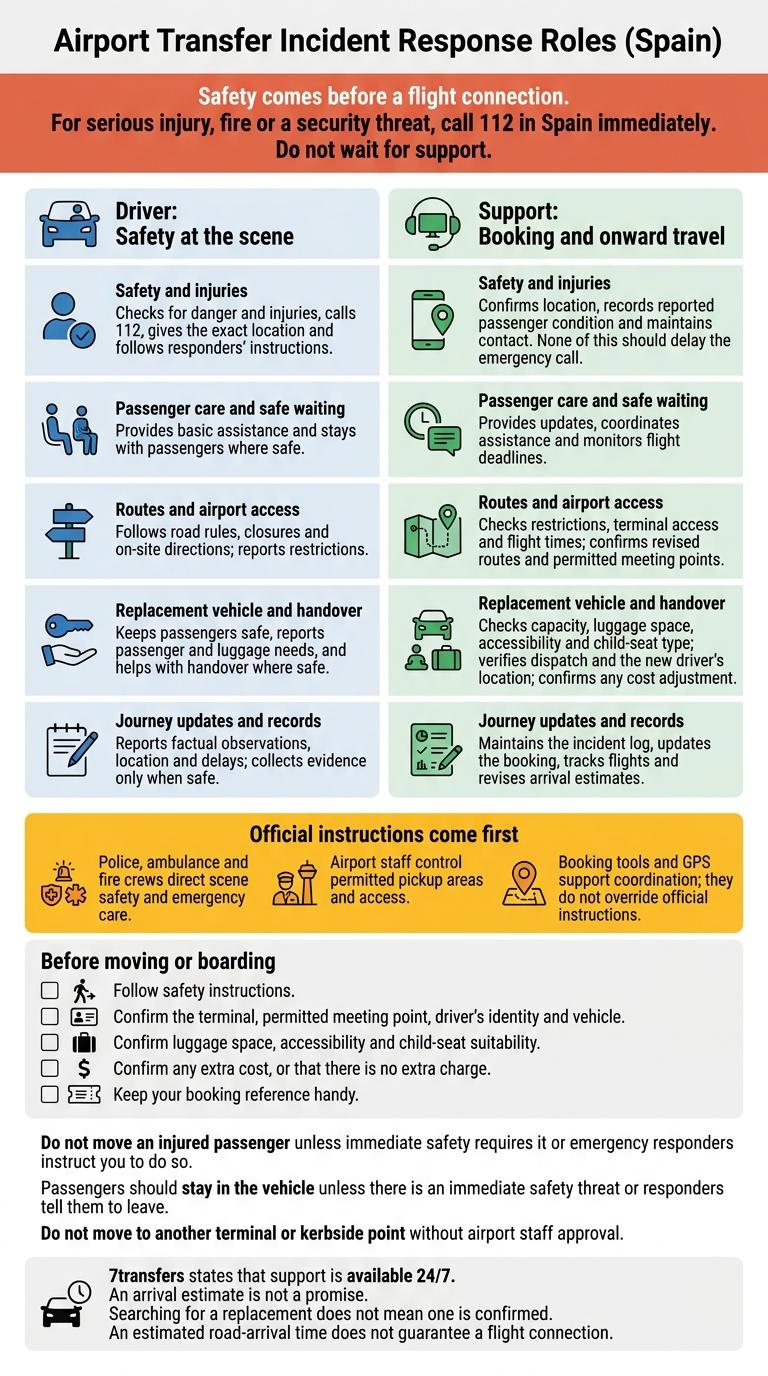
My first step in a serious airport transfer emergency in Spain is to call 112 - not wait for support. The driver handles safety at the scene; support handles booking changes and onward travel. Emergency services and airport staff direct safety and access.
Here’s how I separate the roles:
- Driver: Checks for danger and injuries, follows responders’ instructions, helps passengers and reports what happened.
- Support: Provides updates, checks routes and flight times, and arranges replacements with the right luggage space, child seats and accessibility features.
- Passengers: Follow safety instructions and confirm the meeting point, driver, vehicle and any extra cost before continuing.
7transfers states that support is available 24/7, but an arrival estimate is not a promise. I would confirm a replacement’s suitability before boarding and keep my booking reference handy.
Quick Comparison
| Task | Driver | Support |
|---|---|---|
| Safety and injuries | Checks the scene, calls 112 and follows responders | Keeps contact and records updates |
| Route and airport access | Follows road rules and on-site directions | Checks restrictions and confirms travel changes |
| Replacement vehicle | Helps with safe waiting and handover | Checks passenger needs, dispatch and costs |
| Journey updates | Reports location and delays | Shares revised estimates and tracks flights |
<u>Safety comes before a flight connection.</u> If the driver is missing at arrivals, I check the meeting instructions, call the driver, then contact support with my booking reference.
Airport Transfer Emergencies: Driver vs Support
Immediate Safety and Passenger Care
Once the scene is safe, divide the response between care at the scene and remote coordination.
Safety comes before reaching the airport. For serious injury, fire or a security threat, call 112 in Spain immediately. Police, ambulance or fire crews take charge of the scene when they arrive.
Driver Duties at the Scene
The driver stops safely, uses hazard lights where appropriate, checks for danger and injuries, and gives 112 the exact location. Passengers should stay in the vehicle unless there is an immediate safety threat or responders tell them to leave. Do not move an injured passenger unless immediate safety requires it or emergency responders instruct you to do so.
The driver follows responders’ instructions, provides basic assistance and stays with passengers where safe. Once urgent needs are addressed, they record the facts and update support. Geotagged, timestamped photos in the 7Transfers Driver App support the record.
Support Duties and Passenger Updates
Support manages the booking and passenger updates, opens an incident record, and confirms the location, passenger condition, destination and flight deadline. None of this should delay the emergency call.
Booking details help identify accessibility and child-seat needs. Support logs each update and revises arrival estimates as conditions change. Estimates must never be presented as guarantees.
Passenger Care Duties Compared
| Passenger-care task | Driver responsibility | Support responsibility | Emergency-service involvement |
|---|---|---|---|
| Physical safety | Assess danger and secure the vehicle where safe | Confirm location and maintain contact | Direct scene safety and traffic control |
| Injury response | Check for injuries, call 112 and provide basic assistance | Record the reported passenger condition | Provide medical assessment, treatment and transport |
| On-scene reassurance | Explain what is happening calmly | Confirm journey status and next steps remotely | Give instructions during the emergency response |
| Accessibility and child-seat needs | Help passengers safely; move equipment only when safe | Coordinate a replacement vehicle with the correct equipment | Not needed |
| Safe waiting | Stay with passengers where safe | Coordinate assistance and monitor flight deadlines | Secure the area where a threat exists |
| Disruption updates and follow-up | Report factual observations | Maintain the incident log and revise arrival estimates | Provide official instructions relevant to the response |
If the trip cannot continue, support arranges route changes or a replacement vehicle.
sbb-itb-ff87004
Route Changes and Replacement Vehicles
Once the scene is safe, the focus shifts from rescue to rerouting.
Safe Route Changes and Arrival Updates
The driver checks road safety, and support confirms the revised route. Navigation in the 7Transfers Driver App helps find a safe alternative, but local road rules and closures take priority. Neither team should suggest unsafe shortcuts to protect a flight connection.
| Task | Driver action | Support action | Passenger update |
|---|---|---|---|
| Assess a closure | Reports the restriction, location and a safe alternative | Checks traffic, roadworks and closures; confirms the revised route | Explains the delay |
| Confirm airport access | Reports any access restrictions encountered | Checks the terminal, permitted pickup or drop-off zone and flight time | Shares any change to the meeting point or zone |
| Revise arrival time | Sends location and delay details through the app | Checks traffic and updates the booking | Gives a revised estimate, not a guaranteed arrival time |
An estimated road-arrival time does not guarantee a flight connection. Support confirms the route change before sending new directions.
Replacement Vehicles and Passenger Handover
If the vehicle cannot continue, the driver first secures it and keeps passengers safe. Support then looks for a suitable replacement. Searching for a replacement does not mean one is confirmed. Neither timing nor availability should be promised until dispatch and the new driver’s location have been verified.
| Task | Driver action | Support action | Passenger communication |
|---|---|---|---|
| Match the vehicle | Reports passenger count, luggage and assistance needs | Checks capacity, luggage space, accessibility and child seats against the booking | Explains which needs the replacement can meet |
| Confirm collection | Stays with passengers where safe | Dispatches the replacement and checks its location | Sends driver and vehicle identification, the new meeting point and an updated arrival estimate |
| Pass passenger needs to the new driver | Explains needs and helps with luggage where safe | Records the reassignment and any cost adjustment | Confirms any extra cost, or that there is no extra charge, before onward travel |
| Resume the journey | Checks that passengers and luggage have transferred; the new driver marks the journey as on board in the app | Monitors the journey and updates its arrival estimate | Confirms that the transfer has resumed |
A replacement must meet passenger needs - not just provide enough seats. Support checks luggage and accessibility requirements, and must confirm the child-seat type and any supplement before dispatch.
If access, timing or handover requires official direction, support escalates the case to police or airport staff.
Police Contact and Airport Coordination
Emergency Calls and Police Instructions
The driver calls 112 and follows instructions at the scene. Support records the case and keeps passengers updated. In a serious emergency, call 112 immediately and give the exact location and the passenger’s condition. Use the app’s location data to share the scene’s position without delay.
When an incident requires official intervention, police instructions take priority over the transfer plan. Emergency responders decide when it is safe to move.
| Task | Driver responsibility | Support responsibility | Emergency-service responsibility |
|---|---|---|---|
| Emergency call | Call from the scene and describe the location and passenger condition | Record the reported details and help with communication | Send police, medical or fire units to the scene |
| Scene safety | Follow police, fire and medical instructions | Pass on information if the driver and passengers are separated | Direct scene procedures, traffic control and emergency care |
| Incident records | Provide factual details and collect evidence only when safe | Keep the service case record and update the booking | Carry out the official investigation and prepare police reports |
Airport Access and Changed Meeting Points
Once the scene is under control, airport staff decide where passengers can be picked up or moved. Check the booking’s meeting instructions and the current airport signs. Support confirms the permitted pickup point with airport staff or the ground transport team, while the driver follows on-site directions. Do not move to another terminal or kerbside point without airport staff approval.
| Coordination task | On-site driver action | Remote support action | Airport responsibility |
|---|---|---|---|
| Changed meeting point | Use only a permitted stopping or collection area | Confirm the location with the relevant airport team and notify the passenger | Set permitted areas and enforce access rules |
| Restricted access | Follow signs, checkpoints and police directions | Confirm how the restriction affects collection | Manage access and security checkpoints |
| Emergency disruption | Follow evacuation or detour instructions | Share revised arrangements without directing the emergency response | Police, fire services and airport operations manage the disruption |
Before walking to a changed location, confirm the terminal, the meeting point and whether airport staff permit access.
Support uses live booking data to coordinate the handover, but official instructions always come first.
7transfers Tools for Incident Coordination
At 7transfers, support uses GPS location and booking data to locate passengers and update the booking. These tools help with coordination only. They do not override emergency services or guarantee access or arrival times.
Conclusion: Who Handles Each Incident
The driver handles the scene; support handles the booking and onward travel. Emergency responders take over if someone’s life is at risk or there is a risk of serious injury.
Keep your booking reference, driver’s number and confirmation email handy. If you cannot find the driver, call them first. Then contact 7transfers support and give them your booking reference. Before moving or boarding, confirm the meeting point, driver’s identity and vehicle class.
Duties by Incident Type
| Incident | Immediate lead | Support lead | External authority | Passenger outcome |
|---|---|---|---|---|
| Breakdown | Driver: keeps passengers safe and reports the breakdown | Support: arranges a replacement | - | Suitable replacement vehicle |
| Collision | Driver: handles safety and calls emergency services | Support: provides updates and arranges onward travel | Police and emergency services | Safe waiting; revised travel |
| Illness or injury | Driver: provides immediate assistance | Support: handles communication and trip changes | Medical responders | Emergency assistance; trip suspended if needed |
| Traffic obstruction | Driver: adjusts the route | Support: provides arrival updates | Traffic police, if involved | Revised route and estimated arrival |
| Pickup mismatch | Driver: confirms the location and waits at the assigned point | Support: locates the passenger | Airport security, if access is restricted | Confirmed pickup location |
| Security concerns | Driver or passenger: sounds the alarm | Support: handles communication and keeps records | Police | Safety intervention |
| Weather or airport disruption | Driver: handles safety | Support: coordinates the revised pickup | Airport security or local authorities | Safe waiting or revised travel |
| Accessibility mismatch | Driver: assists the passenger and handles the handover | Support: checks access needs and matches the vehicle | - | Replacement matched to access needs |
For accessible replacements, confirm suitability with support before boarding. Do not assume the replacement meets the access needs specified in your original booking.
FAQs
What if my driver cannot call 112?
If your driver cannot contact emergency services, contact 7transfers customer support immediately. The team is available 24/7 to help with urgent situations during your journey.
Call the support number in your booking confirmation or use the contact options on our website. Have your booking reference ready so the team can help you promptly and coordinate the response needed.
Who pays if an incident makes me miss my flight?
7transfers and its partners are not liable for delays or service failures caused by events beyond their reasonable control, such as traffic, weather or strikes. They do not pay compensation for flights missed because of these events. Liability is generally limited to the amount paid for the service, unless the law requires otherwise.
If an incident occurs, contact 7transfers support immediately so they can help with your situation.
What if no suitable replacement vehicle is available?
If no suitable replacement vehicle is available during a transfer incident, contact 7transfers customer support immediately. Our team is available 24/7 to help, keep you informed and handle the disruption so your journey can continue with as little interruption as possible.
We prioritise assigning another driver when unexpected vehicle issues occur. Customer support remains your main point of contact for resolving service disruptions.