


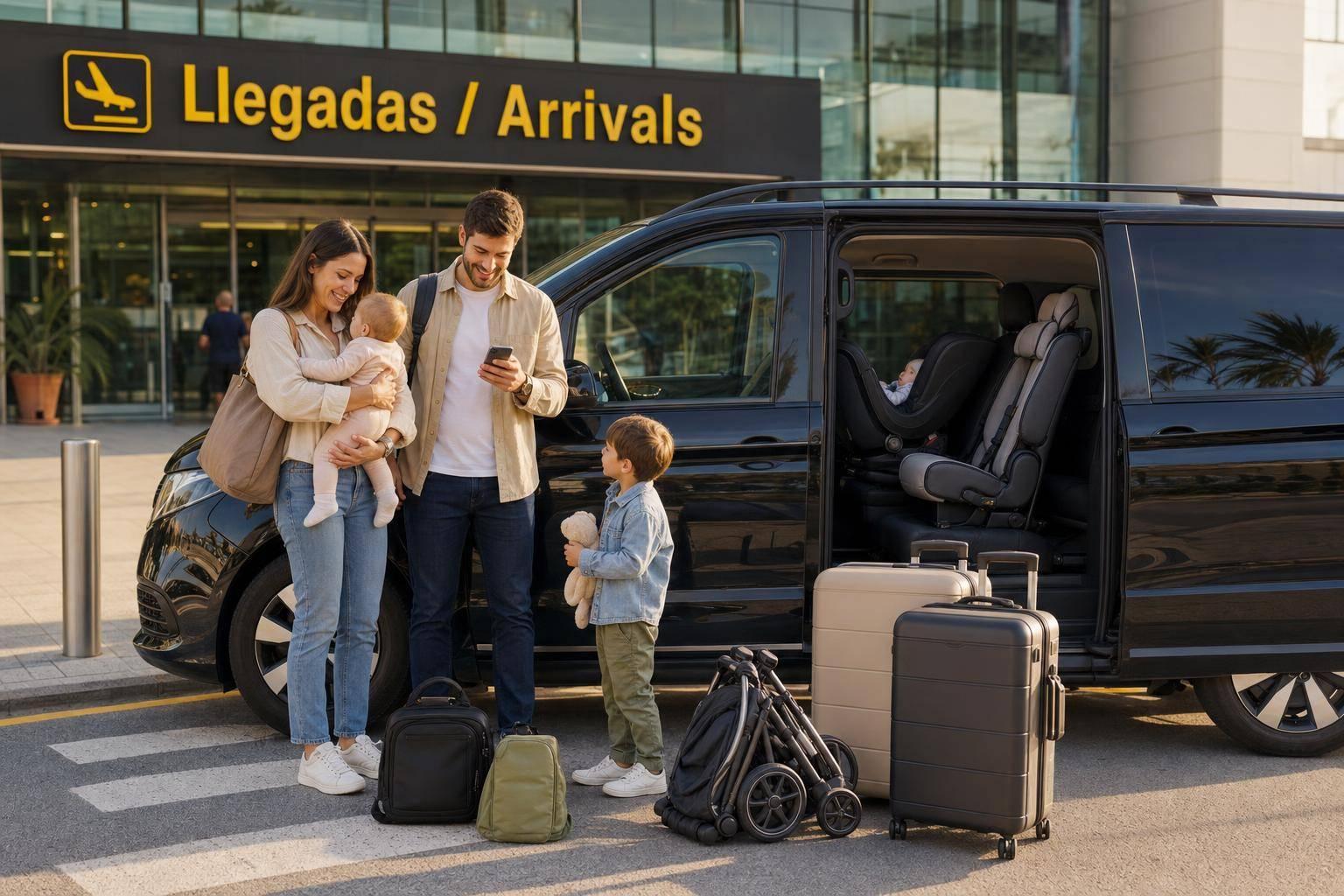
Family Airport Transfer: Bags, Prams, Child Seats
Family airport transfer checklist for Spain: choose the right vehicle, plan pram and luggage, request correct child seats and confirm booking.
Family Airport Transfer: Bags, Prams, Child Seats
If I book a family airport transfer in Spain, I check four things first: vehicle size, pram space, child seats, and the booking confirmation. That avoids the usual problems: not enough boot room, the wrong seat, or delays at pickup.
Here’s the short version:
- I count people, suitcases, prams, and child seats separately
- I treat a pram like an extra large bag
- I give the provider my child’s height and weight, not just age
- I check the confirmation for flight number, waiting time, support contact, and total price in €
A few facts matter straight away:
- In Spain, children under 1,35 m must use an approved restraint
- Airport pickups include 45 minutes of complimentary waiting time in this case
- Free cancellation is available up to 24 hours before pickup
- Travel details should be checked in local format, such as 19/09/2026 and 07:30
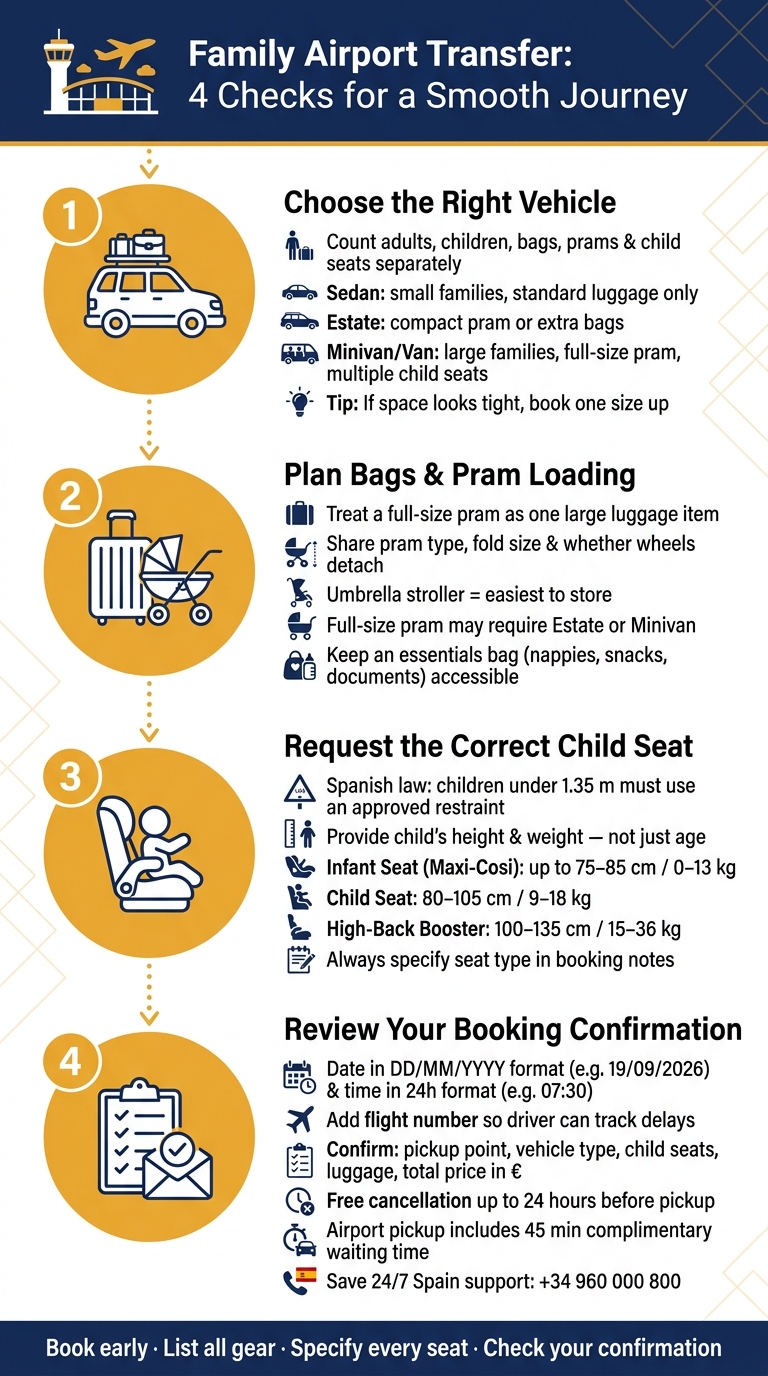
Family Airport Transfer Checklist: 4 Steps for a Smooth Ride
Quick comparison
| What I check | What I look for | Common mistake |
|---|---|---|
| Vehicle | Enough seats and boot space | Booking by passenger count only |
| Pram and bags | Fold size, number of bags, bulky items | Not mentioning a full-size pram |
| Child seats | Seat type, height, weight | Asking for a vague “kids’ seat” |
| Confirmation | Pickup point, flight number, price, contacts | Not reviewing the email after payment |
So before I travel, I keep it simple: book one size up if space looks tight, list bulky gear clearly, and confirm every seat and bag in writing.
sbb-itb-ff87004
Choose a vehicle that fits both people and gear
A vehicle can seat your whole family and still leave you short on boot space. So before you book, count people and luggage separately.
Count passengers, bags, prams, and child seats as separate space needs
Count adults, children, infants, bags, prams, child seats, and any bulky items like a travel cot or sports gear before you book. A pram should be treated like an extra suitcase. And each child seat takes up seating space, which can limit how many people fit in the vehicle.
Match your group to a sedan, estate, or minivan
Use your full luggage count to pick the smallest vehicle that still fits everyone in comfort.
| Vehicle | Best for | Typical fit |
|---|---|---|
| Sedan | Small families with light luggage | Standard suitcases only; limited pram space |
| Estate | Extra boot room for a compact pram or more bags | Fits a compact pram or extra bags |
| Minivan/Van | Large families, multiple suitcases, and several child seats | Multiple suitcases, a full-size pram, and several child seats |
If your group is close to the limit, go up one size.
With 7transfers, you can compare vehicle categories and see the fixed price in EUR (€), with taxes and VAT included, before booking.
Once the vehicle size is set, check how your pram and bags will load at pickup.
Plan bags and prams for easy loading at the airport
Once you know the vehicle size, the next step is simple: make sure the pram and bags will actually fit in the boot.
This is where many families get caught out. Bag count matters, but pram size matters just as much. A full-size pram can take up most of the boot on its own, while a compact stroller folds down smaller and is much faster to load.
Tell the transfer provider the pram type and fold size
Be specific when you book. Share the pram type, whether it folds flat, and whether the wheels detach.
That small bit of detail can save time at the airport. An umbrella stroller usually folds one-handed and is easy to store. A compact travel pushchair is made for fast folding and will usually fit in a standard vehicle boot. A full-size pram, on the other hand, may need an Estate or Minivan. A baby carrier needs no boot space at all.
A travel cot should count as one large luggage item. It’s long, rectangular, and needs a flat surface to sit on. The more exact your notes are, the smoother and faster the loading will be at the airport.
Use a simple luggage plan to speed up loading
A little planning goes a long way here. Group bags by size and load the heaviest ones first, so lighter bags can stack on top without shifting around.
Keep one essentials bag separate and easy to reach. That bag should hold nappies, snacks, and travel documents. It’s the one thing you don’t want buried under everything else.
It also helps to combine smaller items into fewer larger bags instead of spreading them across lots of little ones. Fewer pieces usually means less fuss when it’s time to load up.
With 7transfers, airport pickups include 45 minutes of complimentary waiting time from landing, which gives you extra time to collect your bags and fold the pram.
Child seat rules in Spain and how to request the right seat
Once you know the vehicle has enough room, the next step is to confirm what each child needs. In Spain, children under 1,35 m must travel in an approved child seat or restraint that matches their height and weight. Age helps as a rough guide, but it doesn't decide the seat on its own.
Choose the right seat type: infant seat, child seat, or booster
When you book, share your child's approximate height and weight. That gives the provider what they need to match your child to the right restraint at the time of booking.
| Seat Type | Typical Height / Weight | Typical Use |
|---|---|---|
| Infant Seat (Maxi-Cosi) | Up to 75–85 cm / 0–13 kg | Rear-facing for newborns and young infants |
| Child Seat | 80–105 cm / 9–18 kg | Forward-facing with a 5-point harness |
| High-Back Booster | 100–135 cm / 15–36 kg | Uses the vehicle seatbelt; adds side-impact protection |
A simple way to avoid mix-ups: don't just ask for a "kids' seat". Be specific. If you include the seat type, plus your child's current height and weight, there's much less room for error.
Confirm when the front seat is allowed before travel
For children under 1,35 m, ask for rear-seat placement. The front seat should only be used if no rear seats are available, or if all rear seats are already occupied by children in restraints.
7transfers offers baby seats, child seats, and Maxi-Cosi seats on request. Add the seat type, along with your child's height and weight, in the booking notes. Then check the confirmation email before travel. Seats are subject to availability and may carry a supplement. After that, make sure the seat appears in the booking confirmation.
Book the transfer, then check the confirmation
Add pickup and drop-off points, date, flight number, bag count, and child seats before paying
Once you’ve picked the vehicle and sorted the seats, take a minute to fill in the booking details with care. Add the pickup and drop-off points, the travel date in DD/MM/YYYY format, for example 19/09/2026, and the pickup time in 24-hour format, for example 07:30.
Then add the full trip details:
- total number of passengers
- bags
- pram
- child seat types
It’s also worth adding your flight number. That lets the driver track delays and adjust the pickup time if your flight is late.
Before you pay, check the fare shown on screen. The price is fixed and includes the vehicle, driver, taxes, VAT, and standard fees. After payment, review the confirmation straight away.
Check meet and greet, waiting time, and support contacts after booking
After booking, read the confirmation well before travel day. For airport arrivals, the driver will wait in the arrivals hall with a name sign. Check that the vehicle type matches what you booked. Then look again at the child seats listed on the confirmation.
Standard bookings include free cancellation up to 24 hours before pickup. Save the 24/7 support number for Spain (+34 960 000 800) and the driver’s contact details from the confirmation, so they’re easy to find if plans change on the day.
Before you move on, confirm these details: pickup point, vehicle type, child seats, luggage, flight number, and total price.
Conclusion: Four checks that make family transfers run smoothly
Before you travel, do four final checks: vehicle size, pram details, child seats, and the booking confirmation.
First, choose a vehicle based on the actual number of passengers, bags, prams, and child seats. Second, add your pram and any bulky gear to the booking. Third, request the right child seat type for each child. Fourth, read the confirmation email and check the pickup point, vehicle type, flight number, child seats listed, support number, and driver contact.
These quick checks help you avoid the most common transfer issues: not enough space, missing seats, and confusion at pickup.
For airport pickups, the 45-minute complimentary waiting time gives you extra time to collect your bags and fold the pram.
FAQs
What if my flight is delayed?
No stress. If you add your flight number when you book, 7transfers tracks your flight in real time and adjusts your pick-up time automatically.
Your driver will also wait at the airport for up to 45 minutes at no extra cost. If you need help, customer support is available 24/7.
How much luggage fits in each vehicle?
Luggage capacity depends on the vehicle class you choose when booking. Each vehicle is set up for a set number of passengers and bags, so everyone can travel in comfort.
With 7transfers, you can see the included luggage allowance and hand luggage for your chosen vehicle during the booking process. You can also request child seats or extra equipment at that stage.
Can I bring my own child seat?
Yes. You can request a child seat or booster when booking, subject to availability. A small supplement may apply depending on the route.
After booking, check that your pickup details and passenger information are correct. Then confirm the child seat requirement through your booking confirmation email or the agreed channel.